

Hey there 👋
I have been thinking about the glorious past this week.
That sounds dramatic, I know. Also slightly dangerous, because at 44 I am apparently old enough to be classified as a fossil by some parts of the internet. 😩 A well-preserved fossil, obviously. 😉
But this is not the “everything used to be better” rant. I mean old as in boring in the best possible way. RSS feeds. Newsletters. Configuration files. Small protocols. Tools that do one job and keep doing it long after the hype cycle moved on.
Somewhere along the way, a lot of those things got pushed aside by timelines, feeds, engagement tricks, and platforms that turned our attention into a leaderboard. Then the social landscape split into pieces, Twitter became X (it is still Twitter to me, sorry), and a lot of people started longing for the quieter parts of the web again.
Maybe that is nostalgia. Maybe it is also a sign that we threw away some solid foundations too quickly.
The smart home I still have not automated
I get this question a lot: “How is your new smart home going?”
Well... 😬
The honest answer is that I moved, Home Assistant is running, and a frankly ridiculous amount of the house is already connected to it. My setup currently lists 294 devices. And yet: no dashboard, no automation, no script. Not a single one.
The Ninja, also known as Mrs. Frenck, does not even have access yet. Which is probably not the kind of “family-approved smart home” update people expected from me.
I am honestly not even sure what I am waiting for at this point. There is still plenty to figure out, yes, but the basics are there. More than the basics, really. This house has ACs, a heat pump, a lot more electrical usage than my previous home, and an absolutely stupid amount of automation potential.
I did set up the energy dashboard, because I actually need those insights here. I need to understand how this house behaves before I start being clever about it. Or before I accidentally make something worse, which is also a respected smart-home tradition. 🤣
If you are curious, I did a quick tour of the new place a while back. That was the optimistic “look at all this potential” phase. This is the slightly more honest “why have I not started yet?” phase.
Maybe I need to set up an AI with an MCP to kick me into action. 🤔
Worth your attention
Some other publications that at least, I think they are worth your attention. They got mine, and that is why I’m sharing them here.
The solution might be cancelling my AI subscription
Simon Willison linked to David Wilson’s post about cancelling an AI subscription.
This one stuck with me because it captures a real failure mode of AI tools: they make starting things easier than deciding whether those things should exist. I felt that one a little too much.
Apple and Google add support for Thread 1.4
The Verge covered Apple and Google starting to roll out Thread 1.4 support.
This is not a shiny new smart-home feature. Good. Thread needs the boring interoperability work that makes the foundation less annoying, and this is exactly the kind of old-fashioned plumbing the smart home still needs.
Also worth noting: Home Assistant 2026.6 now ships with Thread 1.4 too. It was pulled out of beta, which matters because boring foundation work only becomes useful when enough of the stack actually ships it.

The ghost in the dependency tree
OpenSSF talked about open source end-of-life dependencies.
Old dependencies do not disappear because we stopped looking at them. They just sit there quietly until one day they become everyone’s problem. Very nostalgic. Very cursed.
From my desk
That same thread shows up in what I have been building too. Instead of making another AI-targeted thing because that is where the current gravity is, I have been spending time on an old, forgotten, extremely "important" corner: YAML.
Polishing the old. Making the base more solid. Apparently that is the mood this week. The fossil is leaning into it.
🪨 YAMLRocks
I have been working on something called YAMLRocks.
It is a YAML library for Python, written in Rust. Which sounds niche, because it absolutely is. But it also sits in one of those weird corners of software where “niche” quietly means “a lot of people depend on this every single day”.
Home Assistant uses YAML heavily. Not only one file either. Real installations often have a configuration.yaml that pulls in automations, scripts, scenes, packages, dashboards, secrets, and a pile of other files through includes. Those files are parsed at startup, parsed again on reloads, and when something goes wrong, the error needs to point to the actual file and line where the problem lives.
That is where existing Python YAML tooling has always felt like a trade-off: fast, modern, or kind to the document humans wrote. Pick two, if you are lucky.
YAMLRocks 🪨 is my attempt to stop choosing between those things.
It is Rust-backed, YAML 1.2 by default, has a YAML 1.1 compatibility mode, is safe by default, understands includes natively, can preserve source locations, and can round-trip documents while keeping comments, anchors, and formatting intact.
That last part matters more than it sounds. If a tool edits your YAML, it should not destroy the comments, spacing, quoting, and structure you carefully put there. A configuration file is not only data. It is also something a human has to understand at 23:41 when the lights did not turn off and everyone is looking at you.
The project is still early, pre-1.0 software, so this is not me declaring victory and walking away. But the direction is already clear: Python deserves YAML tooling that is fast, modern, correct, and kind to the files people actually write.
If you want to poke around: yaml.rocks has the docs and the story, and the code lives on GitHub.
And while you are visiting that GitHub repo... maybe considering giving it a ⭐! 🫶
One thing I’m thinking about
Maybe newsletters were not the regression...
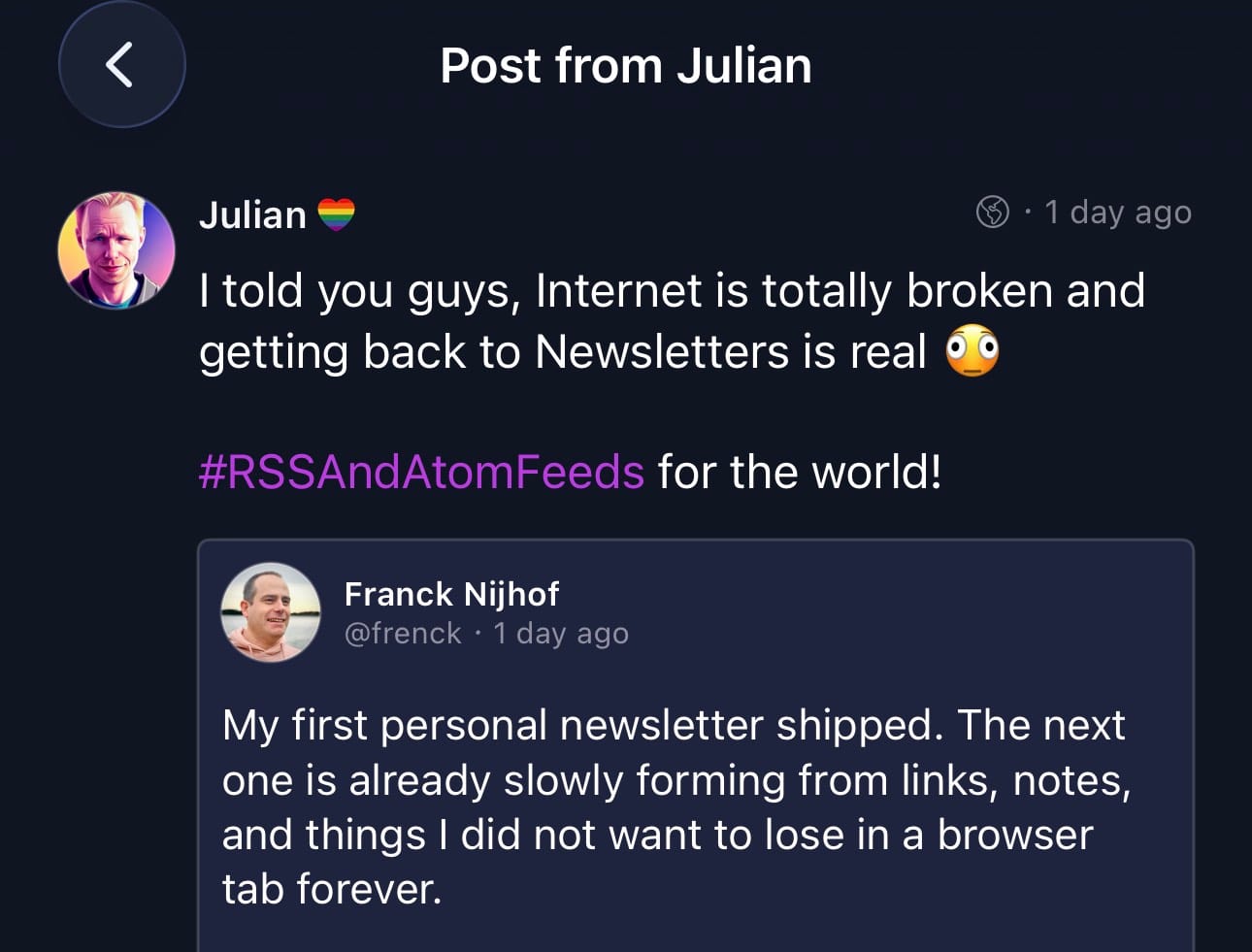
Julian replied to my first newsletter post with: “Internet is totally broken and getting back to Newsletters is real”.
Honestly? Same.
There is a weird kind of comfort in seeing newsletters and RSS come back into focus. Not because they are new. They are not. That is the point.
Before everything became a timeline, a recommendation engine, or a browser tab graveyard, there was a simpler contract: you picked the people and sites you cared about, and new things showed up when they published them. No engagement bait. No “for you” page pretending to know your soul. Just the internet, slightly less desperate for your dopamine.
Then social media ate the room. For a while, that felt convenient. Everyone was there. The links were there. The conversations were there. Then the platforms started splitting, gamifying, and optimizing every corner of themselves until the thing we liked became the thing we had to manage.
Twitter becoming X is the loudest example, and yes, I am still going to call it Twitter because some habits deserve to survive. 😛 But it is not only Twitter. The broader social web has become fragmented, overloaded, and weirdly exhausting. You post in one place, read in another, miss half the people you care about, and somehow still end up seeing more outrage than useful thought.
That is where the longing comes from, I think. Not because the old web was perfect. It was not. But because some of its boring pieces gave us control. RSS feeds let me decide what to follow. Newsletters let someone speak directly to readers without begging an algorithm for permission. A personal site was a place, not just a profile inside someone else’s machine.
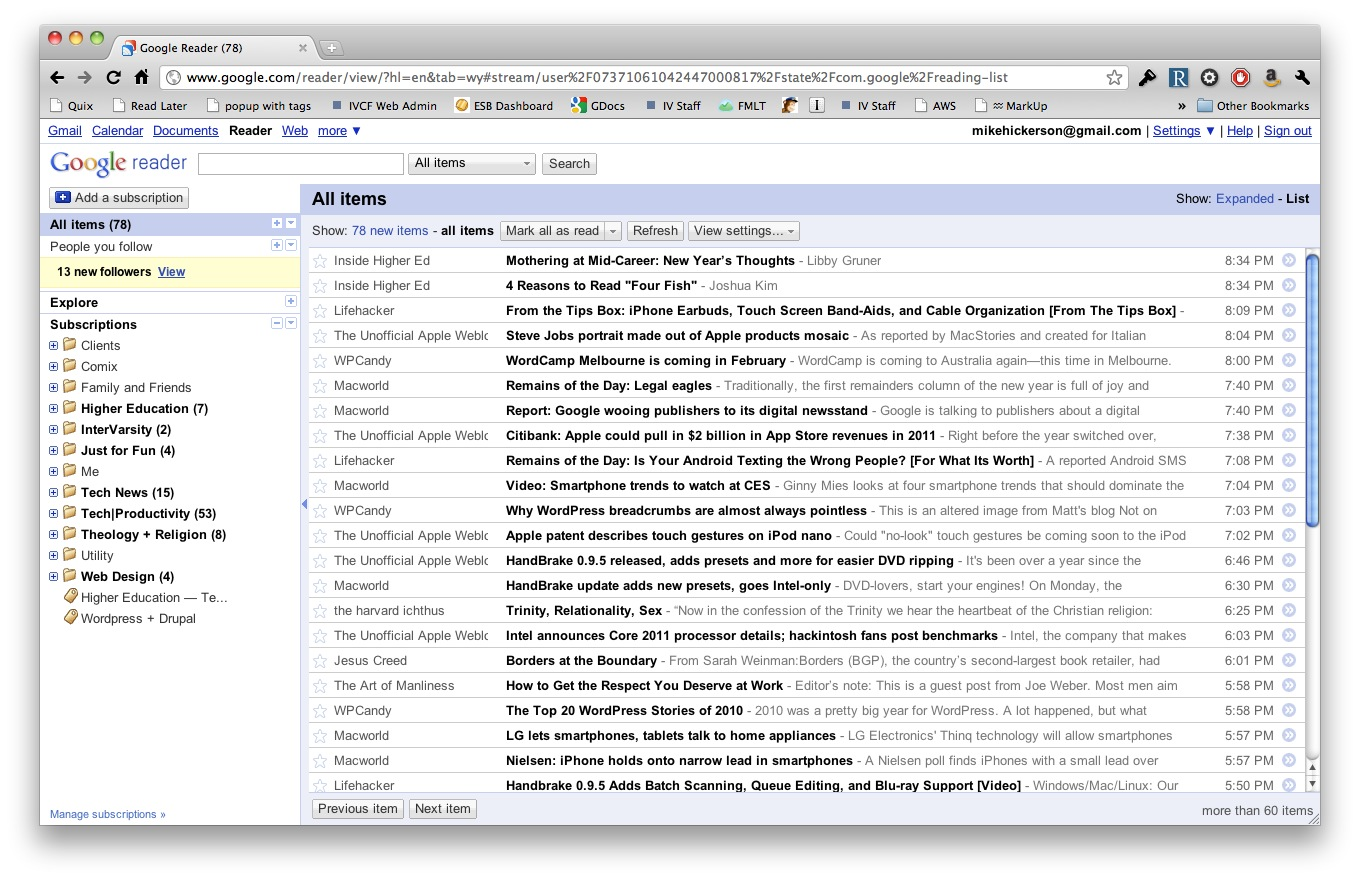
Google Reader disappearing still feels like one of those small internet events that had much larger consequences than we admitted at the time. We did not just lose a product. We lost a default way of following the web on our own terms.
That same feeling is also part of why I have been working on YAMLRocks 🪨. It is not the flashy thing to build right now. It is not another AI wrapper, another chatbot, or another “agentic” anything. It is me looking at an old, important, slightly neglected foundation and thinking: this still matters. Let’s make it better.
Maybe that is the theme of this issue: polishing the old, because we need solid bases. The future does not get better by only stacking shiny new things on top of foundations we stopped maintaining.
So yes, this newsletter is partly practical. A place for links, notes, Home Assistant things, open source thoughts, and whatever else survives real life.
But it is also a tiny vote for that older, better idea of the internet: subscribe to the things you care about, read them when you want, and let the algorithm yell into someone else’s void.
That’s it for this one
Yay! I got the second newsletter out to you!
I'm writing this last bit while I'm also shipping Home Assistant 2026.6.3 in another tab. Why? Because it is Friday! We always ship a patch release on Friday. I like the consistent cycle, it is like the drum beat of the project. 🥁
For the upcoming week, my plan is to really fix Matter in my own smart home... 😫 I might come back with a rant on how that went next time 😬
../Frenck
One more thing
Because I'm that old 😆